
(warning: this article features an image of mummified human remains)
In general, I don’t consider myself to be the morbid type. I’ve never had a particular fascination with death and the majority of exhibits centered around human remains–like Body Worlds, for example–fail to pique my interest.
So a few years ago, when I started researching bog bodies, I guess you could say my interest in them was a bit out of character.

I don’t remember how exactly I first stumbled across articles about the bodies, or what had drawn me to bogs in general. A safe assumption is that I was busy researching something or another about European history. But that’s not really relevant to this article. The ultimate result was that I found myself completely fascinated by these ancient bodies and the bogs that helped preserve them.
The unique chemistry of peat bogs offers just the right conditions to slow or halt the decay of organic matter. The acidity of the water, low oxygen levels, and cold weather all play key roles in the preservation of the unfortunate folks who met their end in one of the bogs (or, in many cases, were placed there after death). Once exposed to the normal atmosphere, they begin to rapidly decay, making swift preservation a top priority if they’re to be used in research.
Bog bodies have been discovered more frequently over the last few centuries, ever since large quantities of peat began to be harvested as a source of fuel. Somewhere upwards of 50 bodies have been successfully preserved following discovery. Sometimes they’re half-mangled by machinery before anyone realizes what they’ve discovered, and often they are so well-preserved that they’re mistaken for recent murder victims. In fact, the majority of bog bodies date back to the iron age, and some even further than that.
How and why these bodies end up submerged in the bog is often something we’re unable to answer. It is not uncommon for them to have suffered a violent death. Hangings, stabbings, bludgeonings, and stranglings are all relatively run-of-the-mill with bog bodies. Some were staked to the bottom of the bog after death, perhaps in an effort to prevent their becoming a Wiedergänger (or Draugr, or Zombie–pick whichever). It has been speculated that these bodies might have been used in a sort of ritual sacrifice, or killed and left in the bog as criminal punishment. In many cases, we’ll likely never know for certain.
Living in California, there isn’t exactly a plethora of bog bodies on display in my area. While bodies have been found in some regions of the Americas, my understanding is that the display of them is considered offensive to many indigenous cultures, and so I haven’t had the opportunity to come face-to-face with one of these well-preserved ancient faces until recently, when I visited London.
Tucked into a quiet and largely ignored corner of the British museum is the body of a young man. He is estimated to have been in his mid-20s at the time of his death. He was of a slight build, slightly shorter than the average modern man, with a neatly trimmed beard and manicured fingernails. His hair and beard are still clearly visible. His features are slightly misshapen now, but still clearly human and recognizable. Sometime in the late Iron Age or early Romano-British period, he ate a final meal of charred bread, and then was strangled, bludgeoned, and had his throat cut before his body was placed face down in the bog known as Lindow Moss.
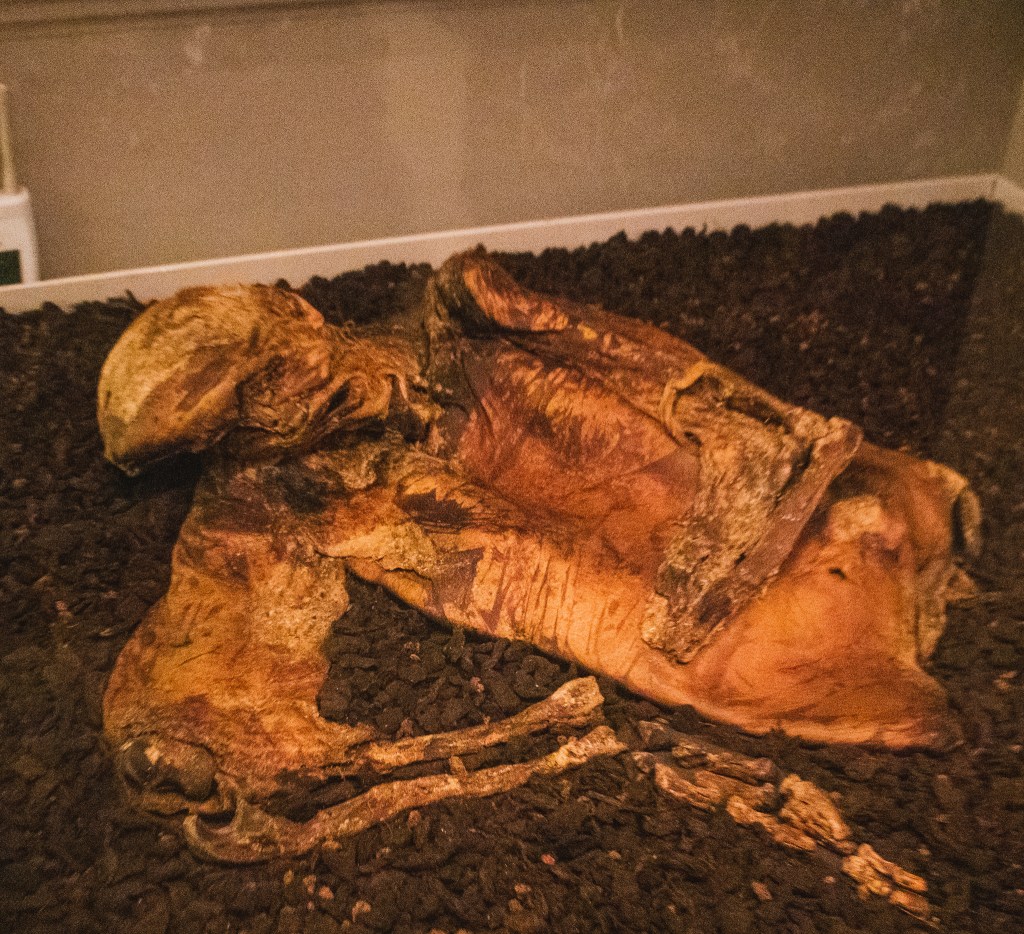
I was somewhat surprised that, on a busy Sunday, there was no one visiting the Lindow Man. When his body was discovered in 1984, the find revitalized British interest in bog bodies. He is the only such body on display in the British Museum–other bodies include multiple Egyptian mummies, which seemed to be much more popular with visitors. I returned again on Tuesday morning to find him alone once again. At that point, I took a few pictures, though admittedly it felt a bit weird to be photographing someone’s remains (no matter how old).

We don’t know who the Lindow Man was and we don’t know why he was killed. His grooming has led researchers to speculate that he was likely of high status, and not subjected to rough work. His death has been described as ritualistic, due to the variety of injuries inflicted. Still, he was someone–a life that now lies forever on display, so that the world can glimpse a face millennia old.
It’s been speculated that peat bogs might have had some liminal significance to ancient Germanic and Celtic cultures. The bogs featured in literature seem to suggest this significance is pervasive even today. For my part, I feel that bogs are most certainly liminal spaces–places where the slow decay of time is placed in a bizarre hold, both in the abstract sense and quite literally.
Seeing first-hand the bogs–and bog bodies–of ancient Europe has done nothing to quell my fascination with them. There is an unmistakable draw to these places that have so long held significance for European peoples. It seems appropriate that the same bogs apparently revered by ancient people have preserved those very people, so that we might better understand them.


 Kristyn J. Miller
Leave a reply to Vera Kabushemeye Cancel reply